Tuesday, June 25, 2013

Hacking a car is way too easy


SALON


Hacking a car is way too easy

Could Michael Hastings' car crash have been caused by a remote attack? Technically, yes


Hacking a car is way too easy (Credit: Henrik5000 via iStock/Salon)


Conspiracy theories about the cause of the car crash that killed investigative reporter Michael Hastings on June 18 started sprouting immediately after the news of his death broke. So far,  no conclusive evidence supports foul play, but on Monday, counterterrorism expert Richard Clarke made news when he told the Huffington Post that the circumstances of Hastings’ car chase were “consistent with a car cyber attack.”

While hastening to state that he was not saying he believed the crash was a purposeful attack, Clarke did observe, reported the Huffington Post, that “‘There is reason to believe that intelligence agencies for major powers’ — including the United States — know how to remotely seize control of a car.”
Clarke served during both Bush presidencies and under Bill Clinton, so presumably he wasn’t speaking completely off the cuff. But just what is a “car cyber attack”?

The answer can be found in two alarming papers by researchers at the University of Washington and the University of California, San Diego, “Experimental Security Analysis of a Modern Vehicle,” and Comprehensive Experimental Analyses of Automotive Attack Surfaces.

Taken together, the papers make for scary reading. In the first the researchers demonstrate that it is a relatively trivial exercise to access the computer systems of a modern car and take control away from the driver. The second demonstrates that such mayhem can be achieved remotely, via a variety of methods. The inescapable conclusion: The modern car is a security disaster.
Modern automobiles are no longer mere mechanical devices; they are pervasively monitored and controlled bydozens of digital computers coordinated via internal vehicular networks. While this transformation has driven major advancements in efficiency and safety, it has also introduced a range of new potential risks… We demonstrate that an attacker who is able to infiltrate virtually any Electronic Control Unit (ECU) can leverage this ability to completely circumvent a broad array of safety-critical systems. Over a range of experiments, both in the lab and in road tests, we demonstrate the ability to adversarially control a wide range of automotive functions and completely ignore driver input — including disabling the brakes, selectively braking individual wheels on demand, stopping the engine, and so on.

We have endeavored to comprehensively assess how much resilience a conventional automobile has against a digital attack mounted against its internal components. Our findings suggest that, unfortunately, the answer is “little.”
The researchers’ findings are not theoretical. They were able to attack a 2009 model sedan and render its brakes ineffective while a test driver was operating the car.

The computerization of the modern car has been aggressively evolving for decades. (Ironically, the researchers credit California’s clean air laws in the 1970s with providing the first incentive for moving car engines into the digital era.) But it might come as a surprise to the average person just how interconnected and accessible today’s high-tech cars are. “Such [computer] systems have been integrated into virtually every aspect of a car’s functioning and diagnostics, including the throttle, transmission, brakes, passenger climate and lighting controls, external lights.”

There turn out to be multiple pathways for car hackers. Diagnostic tools used by mechanics can give hackers laptop access to critical systems. If an attacker is able to get a music file preloaded with malware onto your iPod, just plugging it into a car’s USB port could give that attacker full access. Nearly all new cars now have two-way cellular capability necessary for such systems as GM’s On-Star that are purposely designed to faciliate access to all-important systems.

Your car, ultimately, might be more vulnerable to attack than your computer or smartphone, because there’s little evidence that there has been any systematic thought devoted to vehicle cyber-security. Quite the opposite. Cars are increasingly designed to allow remote access via a variety of input systems.
Just one more reason why we should all be riding bikes.
Andrew Leonard Andrew Leonard is a staff writer at Salon. On Twitter, @koxinga21.

Was Michael Hastings Murdered? Internet Conspiracy Theories Are Rife

PolicyMic


Was Michael Hastings Murdered? Internet Conspiracy Theories Are Rife

Medha Chandorkar


was, michael, hastings, murdered?, internet, conspiracy, theories, are, rife,


Was Michael Hastings Murdered? Internet Conspiracy Theories Are Rife 


Michael Hastings's words have immense power.

A writer at both Buzzfeed and Rolling Stone, Hastings was an award-winning journalist who had no fear in reporting the truth. He's taken on Hillary Clinton aide Philippe Reines on Benghazi, done an exclusive interview with Wikileaks founder Julian Assange, and profiled Taliban captive Bowe Bergdahl. Most memorably, Hastings's 2010 scathing article on General Stanley McChrystal created so much backlash that McChrystal was forced to resign.

That kind of history is guaranteed to create some enemies, and Hastings surely had quite a few. It is also likely to make people very, very scared when you're writing your next big story.

On June 17, at 1 p.m., Hastings sent out an email to Buzzfeed staff and a close friend. The subject line read "FBI Investigation, re:NSA," and the email is as follows:

Hey [redacted] the Feds are interviewing my "close friends and associates." Perhaps if the authorities arrive "BuzzFeed GQ," er HQ, may be wise to immediately request legal counsel before any conversations or interviews about our news-gathering practices or related journalism issues.

Also: I'm onto a big story, and need to go off the rada[r] for a bit.

All the best, and hope to see you all soon.

Michael

Less than 24 hours later, at 4:20 AM, Michael Hastings's car smashed into a tree on Hollywood Avenue and burst into flames. He died immediately.

Whenever a high-profile, the internet is rife with theories. In this case, some have cited several suspicious circumstances in the accident.

Here are some of the more shadowy details:

First, it's obvious that Hastings was working on a big story, though the exact subject is under debate. Considering the title of his email and his last article on BuzzFeed, many (including the Guardian's Glenn Greenwald) think it may have been a piece on PRISM. The Huffington Post thinks he was writing about General Petraeus, while the Los Angeles Times stated that it was on a privacy lawsuit against the Department of Defense and the FBI. They are all big, government-related cases that many would prefer go unexamined.

Second, Hastings reached out to the legal team at Wikileaks for assistance, claiming that that FBI were investigating him. Wikileaks has also claimed that there is a "non-public complication" in Hastings' death, though they have not released more information.

Third, while is it ordinary protocol for police departments to issue a statement that there was no foul play (as the LAPD have done), the FBI hardly ever responds to media attention. However, in this case, they have made an exception. The FBI has released a statement denying that they were ever investigating Hastings, which is interesting considering that after years in his field, Hastings is well aware of what being investigated by the FBI looks like.

Fourth, the car accident itself was pretty bizarre. When the car hit the tree, the engine ejected and was later found over 100 feet away. That kind of ejection is pretty unusual, especially for a Mercedes, and it also meant that Hastings would have had to be driving close to 100 mph, which is much faster than that section of road permits. Here's what the traffic cams caught:

None of this is conclusive evidence, and if viewed individually, they might be dismissed.  But put together, along with Hastings' background and the current air of suspicion regarding government secrecy, it's impossible not to wonder.

Picture Credit: Mother Jones

Hours before death, Journalist Michael Hastings claimed the FBI was on his tail


Hours before death, Hastings claimed the FBI was on his tail

 
Published time: June 24, 2013 19:29 

Edited time: June 25, 2013 16:49 
 
Michael Hastings.(AFP Photo / Paul Morigi)
The death of journalist Michael Hastings is raising new questions after an email he sent hours before last week’s fatal car crash has surfaced showing a possible FBI probe into the reporter.

KTLA News in Los Angeles received an email on Friday that was forwarded to them by a friend of the 33-year-old reporter.

Hastings, who wrote for Rolling Stone and the website BuzzFeed, perished after an auto wreck in L.A. early Tuesday last week.

According to an email Hastings sent Monday afternoon to a handful of friends, he believed his colleagues could be visited by Federal Bureau of Investigation officers due to an article he was working on.

Hey [redacted}, the Feds are interviewing my ‘close friends and associates,’” Hastings wrote, before recommending to his colleagues that they seek legal advice if approached by investigators.

Also: I’m onto a big story, and need to go off the rada[r] for a bit,” he added. “All the best, and hope to see you all soon.”

The Los Angeles Times originally reported that Hastings was working on an article about Florida socialite Jill Kelley at the time of his death, but Hastings' widow, Elise Jordan, said that wasn't the case.

"To correct the record, since I've seen it erroneously reported a few times: @mmhastings was not working on a story about Jill Kelley," Jordan tweeted on Tuesday.

Kelley made headlines last year after she became entangled in a high-profile scandal involving then-CIA Director David Petraeus and Gen. George Allen, who then commanded US troops in Afghanistan. A federal probe of suspicious emails sent to Kelley later unearthed an extramarital affair between Gen. Petraeus and his biographer, Paula Broadwell, which led to the CIA director’s resignation.

Before taking the helm as CIA director, Petraeus commanded US troops in Afghanistan — the same role that later went to Gen. Allen. Petraeus had inherited that role from Gen. Stanley McChrystal. On his part, McChystal resigned from that position after a 2010 Hastings-penned article from Afghanistan raised questions about the commander’s remarks about the Obama administration. He was forced to apologize for comments he made in the article that led to his resignation, and Hastings was presented with a Polk journalism award for his report.

Staff Sgt. Joseph Biggs, who met Hastings when the journalist was embedded in Afghanistan in 2008, said he received the email less than a day before the auto accident and told KTLA it sounded “very panicked.”

It alarmed me very much,” Biggs said. “I just said it doesn’t seem like him. I don’t know, I just had this gut feeling and it just really bothered me,” he said.
He was a good friend of mine,” Biggs wrote in a tweet sent after Hastings’ death.

According to the soldier, Biggs was blind-copied on the email sent mid-day Monday, which was addressed to a handful of Hastings’ colleagues. He died around 15 hours after the email was sent.

One week after his death, speculations continue to surround Hastings’ death. The other recipients of the email obtained by Higgs have yet to address the correspondence, but the soldier said it’s unlikely because others are worried of what will happen next.

The reason I released the email is because those people were too scared. I'm not,” Higgs tweeted over the weekend.

I won't let a man die in vein [sic] because I'm too scared of what will happen to me. If I sent that email to Mike he wouldn't rest,” Higgs wrote, “He would fight.”

On the eve of Hastings’ funeral this Monday in Vermont, Higgs said the deceased journalist’s wife thanked him for releasing the email.

She's vowing to take down whoever did this. She's a fighter,” he wrote.
The Los Angeles Police Department says they do not suspect foul play in Hastings’ death, and the FBI said he was not the target of an investigation.
Appearing on Fox News on Monday, Ali Gharib, a journalist and friend of Hastings, said “I don’t think he was a reckless a person.”

That doesn’t mean he might not have been driving excessively fast,” added Gharib, who said it wouldn’t be “a wild situation” to imagine Hastings driving quickly through Los Angeles late last week.

Speaking to Yahoo News last week, eyewitness Michael Carter wrote that he was nearby at the time of impact and “saw a giant fireball at the base of one of the palms that line the medians” on the road Hastings’ Mercedes was traveling down. “It was surreal. Even from as far away as I was, I could see how violent an impact it had been.”

Correction: This article was updated to include Ms. Jordan's remark.


media

Michael Hastings Sent Email About FBI Probe Hours Before Death

The Huffington Post  |  By Posted:   |  Updated: 06/23/2013 10:56 am EDT


michael hastings email


This undated photo provided by Blue Rider Press/Penguin shows award-winning journalist and war correspondent Michael Hastings. Hastings, an award-winning journalist and war correspondent, died early Tuesday, June 18, 2013 in a car accident in Los Angeles, his employer and family said. (AP Photo/Blue Rider Press/Penguin)

Hours before dying in a fiery car crash, award-winning journalist Michael Hastings sent an email to his colleagues, warning that federal authorities were interviewing his friends and that he needed to go "off the rada[r]" for a bit.

The email was sent around 1 p.m. on Monday, June 17. At 4:20 a.m. the following morning, Hastings died when his Mercedes, traveling at high speeds, smashed into a tree and caught on fire. He was 33.

Hastings sent the email to staff at BuzzFeed, where he was employed, but also blind-copied a friend, Staff Sgt. Joseph Biggs, on the message. Biggs, who Hastings met in 2008 when he was embedded in his unit in Afghanistan, forwarded the email to KTLA, who posted it online on Saturday.
Here's the email, with the recipients' names redacted.
Subject: FBI Investigation, re: NSA Hey (redacted names) -- the Feds are interviewing my "close friends and associates." Perhaps if the authorities arrive "BuzzFeed GQ," er HQ, may be wise to immediately request legal counsel before any conversations or interviews about our news-gathering practices or related journalism issues.
Also: I'm onto a big story, and need to go off the rada[r] for a bit.
All the best, and hope to see you all soon.
Michael
Rumors that the FBI was investigating Hastings began the day after his death, with a couple of mysterious WikiLeaks tweets.

In a rare move, the FBI issued a statement denying that Hastings was under investigation. The Los Angeles Police Department also said it had found no evidence of any foul play in his death.

Hastings, an accomplished war correspondent and sharp political reporter, was best known for writing a critical Rolling Stone profile of General Stanley McChrystal that led to his resignation.

It's unclear what "big story" Hastings was working on prior to his death, but it might have to do with yet another military bigwig, this time retired general David Petraeus.

The LA Times reported that Hastings was researching a story about a privacy lawsuit brought by Jill Kelley, the Florida socialite who took center stage in the Petraeus cheating scandal, against the Department of Defense and the FBI. According to a person close to Kelley, the paper said, Hastings had plans to meet a representative of hers to discuss the case next week.
 

Bush advisor: Hastings crash ‘consistent with a car cyberattack’


Bush advisor: Hastings crash ‘consistent with a car cyberattack’

Published time: June 25, 2013 16:19
Michael Hastings (DC. Paul Morigi/Getty Images for The Guardian/AFP)

A former cybersecurity advisor to President George W. Bush says a sophisticated computer hack could have been the cause of the automobile accident that claimed the life of journalist Michael Hastings last week in Los Angeles.

Richard Clarke, a State Department official-turned-special advisor to several United States presidents, said the early morning auto crash last Tuesday was "consistent with a car cyberattack,” raising new questions about the death of the award-winning journalist.

Hastings died last week when his 2013 Mercedes C250 coupe collided with a tree in Los Angeles, California on the morning of June 18. He was reportedly traveling at a high rate of speed and failed to stop at a red light moments before the single-car crash. He was only 33.

Speaking to Huffington Post this week, Clarke said that a cyberattack waged at the vehicle could have caused the fatal collision.

"What has been revealed as a result of some research at universities is that it's relatively easy to hack your way into the control system of a car, and to do such things as cause acceleration when the driver doesn't want acceleration, to throw on the brakes when the driver doesn't want the brakes on, to launch an air bag," Clarke told The Huffington Post. "You can do some really highly destructive things now, through hacking a car, and it's not that hard."

"So if there were a cyberattack on the car — and I'm not saying there was," Clarke continued, "I think whoever did it would probably get away with it."

The Los Angeles Police Department said they don’t expect foul play was involved in the crash, but an investigation has been opened nonetheless.

In an email reportedly sent by Hastings hours before the crash, he told colleagues that he thought he was the target of a federal investigation.

Hey [redacted}, the Feds are interviewing my ‘close friends and associates,’” Hastings wrote 15 hours before the crash.

Also: I’m onto a big story, and need to go off the rada[r] for a bit,” he added. “All the best, and hope to see you all soon.”

The email was supplied to KTLA News in Los Angeles by Staff Sgt. Joseph Biggs, who says he met Hastings while the journalist was embedded in Afghanistan in 2008. It was reportedly send to a handful of Hastings’ associates and was blind-copied to Biggs.

I just said it doesn’t seem like him. I don’t know, I just had this gut feeling and it just really bothered me,” Biggs told KTLA.

Reporters at Buzzfeed where Hastings worked say they received an email from their colleague, but the Federal Bureau of Investigation issued a statement two days after Hastings’ death to quash rumors that they had been looking into the reporter.

At no time was Michael Hastings under investigation by the FBI,” FBI spokeswoman Laura Eimiller said.

According to the Associated Press, however, Hastings’ fingerprints were on file with the FBI and were used by the bureau to identify his body after flames consumed much the auto wreckage last week.

"I believe the FBI when they say they weren't investigating him," Clarke told the Huffington Post. "That was very unusual, and I'm sure they checked very carefully before they said that."

"I'm not a conspiracy guy. In fact, I've spent most of my life knocking down conspiracy theories," he said. "But my rule has always been you don't knock down a conspiracy theory until you can prove it [wrong]. And in the case of Michael Hastings, what evidence is available publicly is consistent with a car cyberattack. And the problem with that is you can't prove it."

Clarke, 62, spent nearly two decades at the Pentagon before relocating to the White House where he served under President Ronald Reagan and both Presidents Bush. He served as special advisor to President George W. Bush on cybersecurity until leaving the administration in 2003 and is currently the chairman and CEO of Good Harbor Security Risk Management, LLC.

Wednesday, July 11, 2012

Silent Coup


How the CIA is Welcoming Itself Back Onto American University Campuses

Silent Coup

by DAVID PRICE
 
Throughout the 1970s, ’80s and ’90s, independent grassroots movements to keep the Central Intelligence Agency off American university campuses were broadly supported by students, professors and community members. The ethos of this movement was captured in Ami Chen Mills’ 1990 book, C.I.A. Off Campus. Mills’ book gave voice to the multiple reasons why so many academics opposed the presence of the CIA on university campuses: reasons that ranged from the recognition of secrecy’s antithetical relationship to academic freedom, to political objections to the CIA’s use of torture and assassination, to efforts on campuses to recruit professors and students, and the CIA’s longstanding role in undermining democratic movements around the world. 

For those who lived through the dramatic revelations of the congressional inquiries in the 1970s, documenting the CIA’s routine involvement in global and domestic atrocities, it made sense to construct institutional firewalls between an agency so deeply linked with these actions and educational institutions dedicated to at least the promise of free inquiry and truth. But the last dozen years have seen retirements and deaths among academics who had lived through this history and had been vigilant about keeping the CIA off campus; furthermore, with the attacks of 9/11 came new campaigns to bring the CIA back onto American campuses.

Henry Giroux’s 2007 book, The University in Chains: Confronting the Military-Industrial Academic Complex, details how two decades of shifts in university funding brought increased intrusions by corporate and military forces onto university. After 9/11, the intelligence agencies pushed campuses to see the CIA and campus secrecy in a new light, and, as traditional funding sources for social science research declined, the intelligence community gained footholds on campuses.

Post-9/11 scholarship programs like the Pat Roberts Intelligence Scholars Program (PRISP) and the Intelligence Community Scholarship Programs today sneak unidentified students with undisclosed links to intelligence agencies into university classrooms (both were first exposed by this author here in CounterPunch in 2005). A new generation of so-called flagship programs have quietly taken root on campuses, and, with each new flagship, our universities are transformed into vessels of the mi­tarized state, as academics learn to sub­limate unease. 

The programs most significantly linking the CIA with university campuses are the “Intelligence Community Centers of Academic Excellence” (ICCAE, pro­nounced “Icky”) and the “Intelligence Advance Research Projects Activity”. Both programs use universities to train intelligence personnel by piggybacking onto existing educational programs. Campuses that agree to see these outsourced programs as nonthreatening to their open educational and research missions are rewarded with funds and useful contacts with the intelligence agencies and other less tangible benefits.

Even amid the militarization prevailing in America today, the silence surrounding this quiet installation and spread of programs like ICCAE is extraordinary. In the last four years, ICCAE has gone further in bringing government intelligence organizations openly to American university campuses than any previous intelligence initiative since World War Two. Yet, the program spreads with little public notice, media coverage, or coordinated multi-campus resistance. 

When the New Infiltration Began


In 2004, a $250,000 grant was awarded to Trinity Washington University by the Intelligence Community for the establishment of a pilot “Intelligence Community Center of Academic Excellence” program. Trinity was, in many ways, an ideal campus for a pilot program. For a vulnerable, tuition-driven, struggling financial institution in the D.C. area, the promise of desperately needed funds and a regionally assured potential student base, linked with or seeking connections to the D.C. intel­ligence world, made the program financially attractive.

In 2005, the first ICCAE centers were installed at ten campuses: California State University San Bernardino, Clark Atlanta University, Florida International University, Norfolk State University, Tennessee State University, Trinity Washington University, University of Texas El Paso, University of Texas-Pan American, University of Washington, and Wayne State University. Between 2008-2010, a second wave of expansion brought ICCAE programs to another twelve campuses: Carnegie Mellon, Clemson, North Carolina A&T State, University of North Carolina-Wilmington, Florida A&M, Miles College, University of Maryland, College Park, University of Nebraska, University of New Mexico, Pennsylvania State University, and Virginia Polytechnic Institute. 

But the CIA and FBI aren’t the only agencies from the Intelligence Community that ICCAE brings to American university campuses. ICCAE also quietly imports a smorgasbord of fifteen agencies – including the National Security Agency, Defense Intelligence Agency, and Homeland Security. 

ICCAE’s stated goals are to develop a “systematic long-term program at universities and colleges to recruit and hire eligible talent for IC [Intelligence Community] agencies and components,” and to “increase the [intelligence recruit­ing] pipeline of students … with emphasis on women and ethnic minorities in critical skill areas.” Specifically, ICCAE seeks to “provide internships, co-ops, graduate fellowships and other related opportunities across IC agencies to eli­gible students and faculty for intelligence studies immersion,” and to “support selective international study and regional and overseas travel opportunities to enhance cultural and language immer­sion.” ICCAE’s aim is to shower with fellowships, scholarships and grants those universities that are adapting their curricula to align with the political agenda of American intelligence agencies; also to install a portal connecting ICCAE cam­puses with intelligence agencies, through which students, faculty, students studying abroad, and unknown others will pass. While ICCAE claims to train analysts, rather than members of the clandestine service, the CIA historically has not observed such boundaries.
ICCAE-funded centers have different names at different universities. For example, at the University of Washington (UW), ICCAE funds established the new Institute for National Security Education and Research (INSER), Wayne State University’s center is called the Center for Academic Excellence in National Security Intelligence Studies, and Clark Atlantic University’s program is the Center for Academic Excellence in National Security Studies.

With the economic downturn, university layoffs became a common ocurrence. Need breeds opportunism, as scarcity of funds leads scholars to shift the academic questions they are willing to pursue and suspend ethical and political concerns about funding sources. Other scholars unwilling to set aside ethical and political concerns are keenly aware of institutional pressures to keep their outrage and protests in-house.

Covering Up Dissent


Despite a lack of critical media cov­erage of ICCAE programs, traces of campus dissent can be found online in faculty senate records. When Dean Van Reidhead at the University of Texas-Pan American (UTPA) brought a proposal for ICCAE to establish a center on cam­pus, some faculty and graduate students spoke out against the damage to academic freedom that the program would likely bring. Senate minutes record that faculty “representatives spoke against and for UTPA submitting a proposal to compete for federal money to establish an Intelligence Community Center for Academic Excellence.” At this meeting, graduate students “listed the following demands: 1) inform the community via press release about the possible ICCAE proposal, 2) release the proposal draft for public review, 3) establish a commu­nity forum on ICCAE, and 4) abolish the process of applying for ICCAE funds.” At Texas-Pan American, as at other ICCAE campuses, administrators noted these concerns but continued with plans to bring the intelligence agencies to campus, as if hearing and ignoring concerns constituted shared governance.

The minutes of the University of Washington’s Faculty Senate and Faculty Council on Research record shadows of dissent that are so vaguely referenced that they are easily missed. The minutes for the December 4, 2008, meeting gloss over the issues raised when the American Association of University Professors, University of Washington chapter, had issued a strongly worded statement by Executive Board representative Christoph Giebel, requesting information concerning UW’s INSER contacts with the Intelligence Community. The minutes simply read: “… both Giebel and Jeffry Kim [INSER director] answered a series of good questions that resulted in a fair, tough and serious conversation.” What these “good questions” were and the nature of this “tough and serious conversation” are not mentioned in the minutes, as if “good questions” were not important enough to enter into a public record. Similarly, the nature of faculty objections to INSER are glossed over in the 1/29/09 UW Senate minutes, which simply listed the findings of the Faculty Council on Research that “a number of email communications have come through the faculty senate that reflect a range in attitude toward the INSER program.”

In fact, a significant portion of this faculty “range in attitudes toward the INSER program” is most accurately characterized as outraged. I have heard from faculty at other ICCAE flagship campuses that some form of internal dissent has occurred on each of their campuses, and professors at UW have sent me documents, quoted below, clarifying the extent of the campus’s disquiet over the intelligence agencies insertion into their campus; an insertion whose success should be described as a silent coup.

Faculty and students’ public silence at ICCAE universities over these developments needs some comment. The post-9/11 political climate casts a pall of orthodoxy over critical discussions of militarization and national security, and the rise of anti-intellectual media pundits attacking those who question increasing American militarization adds pressure to muzzle dissent. Faculty at public universities often feel these pressures more than their colleagues at private institutions. There are also natural inclinations to try and keep elements of workplace dissent internal, but two factors argue against this public silence. First, most of the ICCAE institutions are publicly funded universities drawing state taxes; the state citizens funding these universities deserve to be alerted to concerns over the ways these programs can damage public institutions. Second, university administrators have been free to ignore faculty’s harsh, publicly silent, internal dissent. Keeping dissent internal has not been an effective resistance tactic.

Inaudible Uproar at UW


In a step moving beyond internal private critiques of ICCAE programs, multiple professors at the University of Washington have provided me internal memos sent by professors to administrators. These memos document the breadth of internal faculty dissent over administrators’ October 2006 decisions to bring the CIA and other intelligence  agencies to the UW campus. 

Initially, the UW administration appeared to appreciate faculty concerns. In October 2005, David Hodge, UW dean of Arts and Sciences, met with School of International Studies faculty to discuss proposals to establish affiliations with U.S. intelligence agencies, after International Studies faculty wrote the administration, expressing opposition to any affiliation linking them with the CIA and other intelligence agencies. This group of faculty wrote that such developments would “jeopardize the abilities of faculty and students to gain and maintain foreign research and study permits, visas, and open access to and unfettered interaction with international research hosts, partners, and counterpart institutions,” and they worried that any such relation­ships would “endanger the safety and security of faculty and students studying and conducting research abroad as well as their foreign hosts.” One participant in these meetings told me that the administration initially acknowledged that there were serious risks that students and faculty working abroad could lose research opportunities because of the CIA-linked program on campus, and that these concerns led the administration initially to decline any affiliation with these intelligence agency-linked programs. 

But these concerns did not derail the administration’s interest in bringing the Intelligence Community on campus, and the following year the administration of UW decided to establish the ICCAE-funded Institute for National Security Education and Research. But after INSER’s launch, concerned internal memos continued to come from faculty across the campus. In the past year and a half, letters voicing strong protest from at least five academic units have been sent by groups of faculty to deans. 

In October 2008, anthropology professors Bettina Shell-Duncan and Janelle Taylor drafted a critical memo that was voted on and approved by the anthropology faculty and then sent to Dean Howard, Dean Cauce, and Provost Wise, raising fears about the damage INSER could bring to the University:
“As anthropologists, we also have more specific concerns relating to the nature of our research, which involves long-term in-depth studies of communities, the majority of which are located outside the United States. Some of these communi­ties are very poor, some face repressive governments, and some are on the receiving end of U.S. projections of military power … our profession’s Code of Ethics requires first and foremost that we cause no harm to the people among whom we conduct research.”
Shell-Duncan and Taylor tied disc­plinary concerns to anthropology’s core ethical principles and raised apprehen­sions that INSER funding could convert the university into a hosting facil­ity for “military intelligence-gathering efforts.”
They pointed to:
“1) the reports that students are required to submit to INSER at the end of their studies, and 2) the debriefing that they are required to undergo upon their return. Although our faculty have already been asked [to be] academic advisors for students with INSER funding, we have never been given any information on the guidelines for the reports, or the nature, scope or purpose of the debriefing process. This is of particular concern given that National Security is not an academic field of study but a military and government effort. Unless and until we are provided with clear and compelling information that proves otherwise, we must infer that these reports and debriefings are, in fact, military intelligence-gathering efforts.”
They cited a 2007 report (of which I am a co-author) written by an American Anthropological Association (AAA) commission, evaluating a variety of engagements between anthropologists and the military and intelligence agencies. The anthropologists argued that this AAA report found that while,
“…some forms of engagement with these agencies might be laudable, the Commission also issued cautions about situations likely to entail violations of the ethical principles of our profession. In particular, the members of the Commission expressed serious concern about ‘a situation in which anthropologists would be performing fieldwork on behalf of a military or intelligence program, among a local population, for the purpose of supporting operations on the ground.’” 

Other academic departments wrote the UW administration expressing concerns. In November 2008, members of the Latin American Studies division in the Henry M. Jackson School of International Studies complained to the administration in a memo that
“in light of the U.S. Intelligence Community’s extensive track-record of undermining democracies and involvement in human rights violations in Latin America and elsewhere, we find it unconscionable that the UW would have formal ties with the newly created Office of the Director of National Intelligence (ODNI), let alone involve our students in an exercise of gathering intelligence information and assist it with its public relations campaign among children in our local schools. The most recent examples of the U.S. Intelligence Community’s inexcusable behavior in Latin America are torture at Guantanamo detention centers, collaboration with the infamous School of the Americas, the backing of paramilitary forces as part of the ‘drug war,’ … and support for the failed coup in Venezuela…
“…Some would argue that UW should engage the Intelligence Community as a method of constructively influencing or reforming it. To our mind, this argument is naïve and misguided at best. The training we provide is unlikely to change the deeply entrenched institutional cultures among the various entities, such as the CIA, which form a part of ODNI. In effect, then, we would be enabling the Intelligence Community to be more effective at carrying out their indefensible activities … We realize that the UW faces a number of financial constraints, perhaps now more than ever, but the needs for monies can never justify collaboration with an Intelligence Community, which is responsible for hundreds of thousands of deaths and immeasurable human suffering throughout the world.”
Also at UW a group of Southeast Asian Studies Center faculty and members of the History Department questioned whether the administration had considered how the presence of INSER on campus would taint professors and students because, in the words of the group in the History Department, “The professional bodies of many disciplines and professional programs have barred members from participating in programs funded by groups like the CIA due to the ethical conflicts such a relationship would involve. Did the administration take this into account in the process of creating INSER? Are there steps taken in the administration of funds from INSER to prevent faculty from unknowingly compromising their professional and ethical obligations?”

Among the problems facing the UW administration in creating INSER was finding an academic structure to administer such a stigmatized program. Because the social sciences represented hostile territory, administrators looked to the Information School. But many Information School faculty weren’t happy about having to house INSER. A letter signed by a dozen faculty from the International Studies Fund Group Librarians expressed deep concerns that that housing “a CIA Officer in Residence” would pollute perceptions of them in ways that could “damage our ability to serve the [other campus constituencies],” arguing that their long standing “strategy of impartial professionalism” across the campus “has enabled us to create collections of such depth over the years. It is also this professional indepen­dence that has in the past protected us from undue scrutiny by the governments of the countries that we visit and from which we solicit information sources – sometimes of the most sensitive nature – for our scholarly collections.”  

While it is encouraging to find UW faculty raising ethical, historical, and political objections, it’s far from clear that these private critiques had any measurable effect, precisely because they remained private.

Today, INSER hosts at least one CIA funded post-doc on the UW campus. It is unknown how many CIA-linked employees or CIA-linked students are now on the UW’s campus. We don’t know what all members of the intelligence agencies on campus are doing, but scholars who study the history of the agency know that in the past CIA campus operatives have performed a range of activities that included using funding fronts to get unwitting social scientists to conduct pieces of research that were used to construct an interrogation and torture manual; to establish contacts used to recruit for­eign students to collect intelligence for the CIA; and debriefing of graduate students upon return from foreign travel of research. We know historically that the CIA has cultivated relationships with professors in order to recruit students. When universities import ICCAE programs, they bring this history with them, and, as students from ICCAE universities travel abroad, suspicions of CIA activity will travel with them and undermine the safety and opportunities to work and study abroad for all.

There are many good reasons to keep the CIA off campus, the most obvious ones stress the reprehensible deeds of the agency’s past (and present). For me one good reason is that this Intelligence Community invasion diminishes America’s intelligence capacity while damaging academia. As the Intelligence Community’s “institutional culture” seeps into ICCAE universities, we can foresee a deadening of intellect, weakening American universities and intelligence capacities as scholars learn to think in increasingly narrow ways, described by President Eisenhower half a century ago in his farewell address’s warning that “a government contract becomes virtually a substitute for intellectual curiosity.”
If the United States wants intelligence reform, it needs to fund independent scholarship, not narrow the range of discourse on our campuses by paying cash-strapped universities to house revolving doors between the academy and the CIA. 

Universities need to be places where people can freely explore ideas, but ICCAE inevitably brings chills to open classrooms. How long will it take until students at ICCAE universities start to wonder about who’s reporting on free-flowing discussions in classes? With cadres of future FBI and CIA employees on campus, those who develop dissident political critiques will find themselves opting for a choice between speaking their mind, or keeping silent, or softening harsh honest critiques. As ICCAE students graduate and begin careers requiring security clearances, accounts of academic discussions stand to make their way into intelligence files, as clearance background checks ask for accounts of known “subversive” acquaintances encountered during university years.
These are foreseeable consequences. Now, that the Patriot Act removed legal firewalls prohibiting these forms of political surveillance, the stage has been set for a dark renaissance of the fifties to begin.

Ending the Silence


If students, faculty and citizens are concerned about ICCAE’s impact on our universities, then breaking the silence is the most effective opposition tactic available. Anyone who wants specific information on contacts between university administrators and ICCAE officials and the intelligence community can use state public records laws and federal Freedom of Information laws to request records. Given university administrators’ claims that everything is above board, these records should not be blocked by national security exemptions; if they are, this would be useful to know. Concerned members of individual campuses can use these tools to access correspondence and verify claims by university administrators about the nature of their contact with ICCAE.
Faculty, staff, students, alumni and community members concerned about ICCAE’s presence on university campuses should form consortia online to share information from various campuses and make common cause. ICCAE has made rapid headway because of the internal campus-specific, isolated nature of resistance to ICCAE. Something like an “ICCAE Watch” or “CIA Campus Watch” website could be started by a faculty member or grad student on an ICCAE campus, providing forums to collect documents, stories and resistance tactics from across the country.

Finally, tenured professors on ICCAE campuses, or on campuses contemplating ICCAE programs, need to use their tenure and speak out, on the record, in public: the threats presented by these developments are exactly why tenure exists. If professors like the idea of bringing the CIA on campus, they can publicly express these views, but the split between the public and private reactions to ICCAE helped usher the CIA silently back onto American university campuses. The intelligence agencies thrive on silence. If this move is to be countered, academic voices must publicly demand that the CIA and the Intelligence Community explain themselves and their history in public. 

DAVID PRICE is a member of the Network of Concerned Anthropologist.  He is the author of Anthropological Intelligence: The Deployment and Neglect of American Anthropology in the Second World War, published by Duke University Press. He can be reached at dprice@stmartin.edu


Sunday, April 22, 2012

Underground Bases and Tunnels

Project Camelot Portal


Home Whats New Interviews & transcripts Round Table In Tribute The Big Picture Shorts
Our Goals High Praise About Us Get Involved Questions Contact
_____________________________

The first section of this page was written by
Phil Schneider:

Photo of United States Air Force tunnel boring machine at Little Skull Mountain, Nevada, USA, December 1982. There are many rumors of secret military tunnels in the United States. If the rumors are true, machines such as the one shown here are used to make the tunnels. (Source: U.S. Department of Energy.)

This is a $13 million tunnel boring machine (TBM) used for tunneling at the Nevada Test Site. (Remember that Area 51 is part of the test site.) Many other types of TBMs are used by many government agencies, including the 'nuclear powered TBM' [NTBM] that melts solid rock and leaves behind glass-like walls.

Most tunneling activity is under military installations and all information is highly restricted. Former employees of said facilities have surfaced over the years to talk of massive underground installations in places like Area 51, the Northrop facility in Antelope Valley, California (rumored to have 42 levels), and the Lockheed installation near Edwards, California.

The 'Black Budget' currently consumes $1.25 trillion per year. At least this amount is used in black programs, like those concerned with deep underground military bases. Presently, there are 129 deep underground military bases in the United States. They have been building these 129 bases day and night, unceasingly, since the early 1940's. Some of them were built even earlier than that. These bases are basically large cities underground connected by high-speed magneto-leviton trains that have speeds up to Mach 2. Several books have been written about this activity.

The average depth of these bases is over a mile, and they again are basically whole cities underground. They all are between 2.66 and 4.25 cubic miles in size. They have laser-drilling machines that can drill a tunnel seven miles long in one day. I was involved in building an addition to the deep underground military base at Dulce, which is probably the deepest base. It goes down seven levels and over 2.5 miles deep. I helped hollow out more than 13 deep underground military bases in the United States.


_____________________________

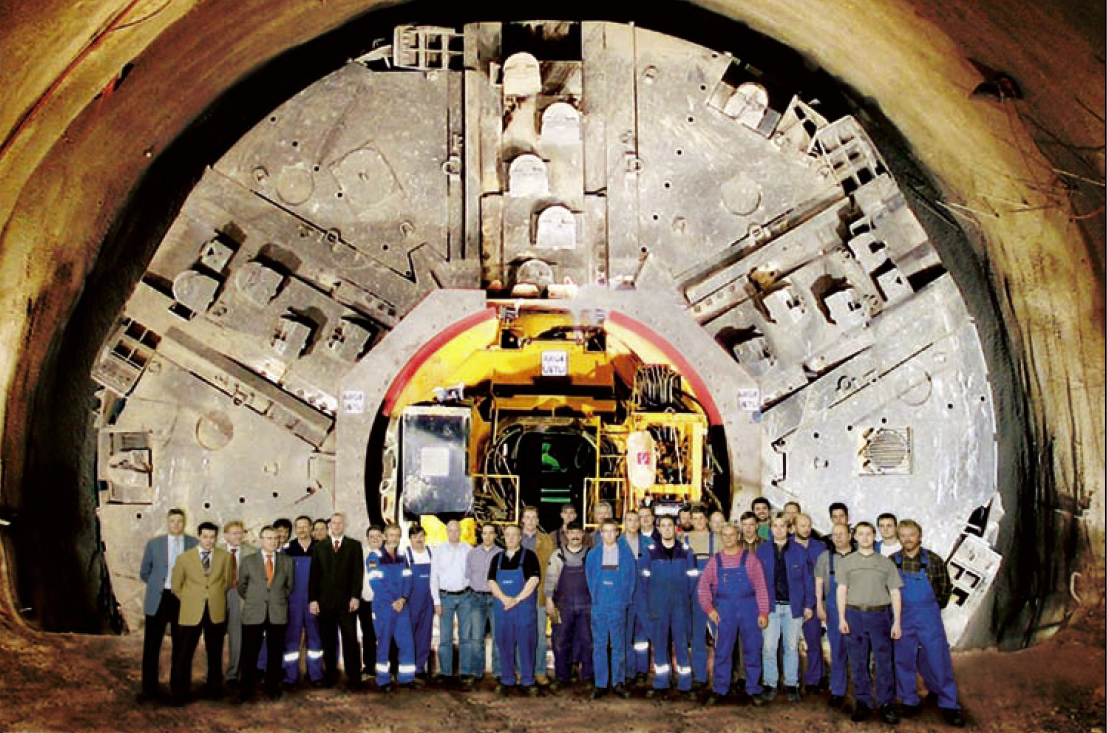
More thought-provoking images of tunnel boring equipment:


_____________________________

From Dr Bill Deagle's
December 2006 Granada Forum Lecture:

I took care of John Fialla, who was best friends with Phil Schneider. How many people know about Phil Schneider? Well, they were using tunneling machines back in the mid-90s that could tunnel through a rock face at seven miles per day, that could cut through a rock face with high-energy impact lasers that could blow the nano-sized particles of rock so that there was no debris left, forming an obsidian-like core, and laying an inner core for unidirectional maglev trains that travel at Mach 2 to 2.8 underground between these very very powerful and organized cities.

There's 132 under the United States, an average of 5.36 to 7.24 cubic miles in size at an average of 1.5 to 4.5 miles underground, built, by and large, most of them in areas away from geotectonic areas - but there's going to be lots of new geotectonic faults established when you have force 11, 12, 13, 14 earthquakes hit the Earth.

Why are they rushing to do this? Because they know that catastrophe is coming. And where's this money coming from? It's not coming from our regular Black Op budget. It's coming from the illegal sale of drugs. In the United States there's at least, by conservative estimates, a quarter of a trillion to a half a trillion of illegal drugs just sold in the United States that goes directly into underground budgets, and 90-95% goes to the DUMBs [Deep Underground Military Bases].
_____________________________

The following was written by
Richard Sauder, PhD, adapted from his book Underground Bases and Tunnels:

The nuclear subterrene (rhymes with 'submarine') was designed at the Los Alamos National Laboratory, in New Mexico. A number of patents were filed by scientists at Los Alamos, a few federal technical documents were written - and then the whole thing just sort of faded away.

Or did it?

Nuclear subterrenes work by melting their way through the rock and soil, actually vitrifying it as they go, and leaving a neat, solidly glass-lined tunnel behind them.

The heat is supplied by a compact nuclear reactor that circulates liquid lithium from the reactor core to the tunnel face, where it melts the rock. In the process of melting the rock the lithium loses some of its heat. It is then circulated back along the exterior of the tunneling machine to help cool the vitrified rock as the tunneling machine forces its way forward. The cooled lithium then circulates back to the reactor where the whole cycle starts over. In this way the nuclear subterrene slices through the rock like a nuclear powered, 2,000 degree Fahrenheit (1,100 Celsius) earthworm, boring its way deep underground.

The United States Atomic Energy Commission and the United States Energy Research and Development Administration took out Patents in the 1970s for nuclear subterrenes. The first patent, in 1972 went to the U.S. Atomic Energy Commission.

The nuclear subterrene has an advantage over mechanical TBMs in that it produces no muck that must be disposed of by conveyors, trains, trucks, etc. This greatly simplifies tunneling. If nuclear subterrenes actually exist (and I do not know if they do) their presence, and the tunnels they make, could be very hard to detect, for the simple reason that there would not be the tell-tale muck piles or tailings dumps that are associated with the conventional tunneling activities.

The 1972 patent makes this clear. It states:

"... (D)ebris may be disposed of as melted rock both as a lining for the hole and as a dispersal in cracks produced in the surrounding rock. The rock-melting drill is of a shape and is propelled under sufficient pressure to produce and extend cracks in solid rock radially around the bore by means of hydrostatic pressure developed in the molten rock ahead of the advancing rock drill penetrator. All melt not used in glass-lining the bore is forced into the cracks where it freezes and remains ...

"... Such a (vitreous) lining eliminates, in most cases, the expensive and cumbersome problem of debris elimination and at the same time achieves the advantage of a casing type of bore hole liner."
There you have it: a tunneling machine that creates no muck, and leaves a smooth, vitreous (glassy) tunnel lining behind.

Another patent three years later was for:
A tunneling machine for producing large tunnels in soft rock or wet, clayey, unconsolidated or bouldery earth by simultaneously detaching the tunnel core by thermal melting a boundary kerf into the tunnel face and forming a supporting excavation wall liner by deflecting the molten materials against the excavation walls to provide, when solidified, a continuous wall supporting liner, and detaching the tunnel face circumscribed by the kerf with powered mechanical earth detachment means and in which the heat required for melting the kerf and liner material is provided by a compact nuclear reactor.
This 1975 patent further specifies that the machine is intended to excavate tunnels up to 12 meters in diameter or more. This means tunnels of 40 ft. or more in diameter. The kerf is the outside boundary of the tunnel wall that a boring machine gouges out as it bores through the ground or rock. So, in ordinary English, this machine will melt a circular boundary into the tunnel face. The melted rock will be forced to the outside of the tunnel by the tunnel machine, where it will form a hard, glassy tunnel lining (see the appropriate detail in the patent itself, as shown in Illustration 41). At the same time, mechanical tunnel boring equipment will grind up the rock and soil detached by the melted kerf and pass it to the rear of the machine for disposal by conveyor, slurry pipeline, etc.

And yet a third patent was issued to the United States Energy Research and Development Administration just 21 days later, on 27 May 1975 for a machine remarkably similar to the machine patented on 6 May 1975. The abstract describes:
A tunneling machine for producing large tunnels in rock by progressive detachment of the tunnel core by thermal melting a boundary kerf into the tunnel face and simultaneously forming an initial tunnel wall support by deflecting the molten materials against the tunnel walls to provide, when solidified, a continuous liner; and fragmenting the tunnel core circumscribed by the kerf by thermal stress fracturing and in which the heat required for such operations is supplied by a compact nuclear reactor.
This machine would also be capable of making a glass-lined tunnel of 40 ft. in diameter or more.

Perhaps some of my readers have heard the same rumors that I have heard swirling in the UFO literature and on the UFO grapevine: stories of deep, secret, glass-walled tunnels excavated by laser powered tunneling machines. I do not know if these stories are true. If they are, however, it may be that the glass-walled tunnels are made by the nuclear subterrenes described in these patents. The careful reader will note that all of these patents were obtained by agencies of the United States government. Further, all but one of the inventors are from Los Alamos, New Mexico. Of course, Los Alamos National Lab is itself the subject of considerable rumors about underground tunnels and chambers, Little Greys or "EBEs", and various other covert goings-on.

A 1973 Los Alamos study entitled Systems and Cost Analysis for a Nuclear Subterrene Tunneling Machine: A Preliminary Study, concluded that nuclear subterrene tunneling machines (NSTMs) would be very cost effective, compared to conventional TBMs.
It stated:
Tunneling costs for NSTMs are very close to those for TBMs, if operating conditions for TBMs are favorable. However, for variable formations and unfavorable conditions such as soft, wet, bouldery ground or very hard rock, the NSTMs are far more effective. Estimates of cost and percentage use of NSTMs to satisfy U.S. transportation tunnel demands indicate a potential cost savings of 850 million dollars (1969 dollars) throughout 1990. An estimated NSTM prototype demonstration cost of $100 million over an eight-year period results in a favorable benefit-to-cost ratio of 8.5.
...Was the 1973 feasibility study only idle speculation, and is the astonishingly similar patent two years later only a wild coincidence? As many a frustrated inventor will tell you, the U.S. Patent Office only issues the paperwork when it's satisfied that the thing in question actually works!

In 1975 the National Science Foundation commissioned another cost analysis of the nuclear subterrene. The A.A. Mathews Construction and Engineering Company of Rockville, Maryland produced a comprehensive report with two, separate, lengthy appendices, one 235 and the other 328 pages.

A.A. Mathews calculated costs for constructing three different sized tunnels in the Southern California area in 1974. The three tunnel diameters were:
a) 3.05 meters (10 ft.)
b) 4.73 meters (15.5 ft.)
c) 6.25 meters (20.5 ft.)
Comparing the cost of using NSTMs to the cost of mechanical TBMs, A.A. Mathews determined:
Savings of 12 percent for the 4.73 meter (15.5 ft.) tunnel and 6 percent for the 6.25 meter (20.5 foot) tunnel were found to be possible using the NSTM as compared to current methods. A penalty of 30 percent was found for the 3.05 meter (10 foot) tunnel using the NSTM. The cost advantage for the NSTM results from the combination of,
(a) a capital rather than labor intensive system,
(b) formation of both initial support and final lining in conjunction with the excavation process.
This report has a number of interesting features. It is noteworthy in the first place that the government commissioned such a lengthy and detailed analysis of the cost of operating a nuclear subterrenes. Just as intriguing is the fact that the study found that the tunnels in the 15 ft. to 20 ft. diameter range can be more economically excavated by NSTMs than by conventional TBMs.

Finally, the southern California location that was chosen for tunneling cost analysis is thought provoking. This is precisely one of the regions of the West where there is rumored to be a secret tunnel system. Did the A.A. Mathews study represent part of the planning for an actual covert tunneling project that was subsequently carried out, when it was determined that it was more cost effective to use NSTMs than mechanical TBMs?

Whether or not nuclear subterrene tunneling machines have been used, or are being used, for subterranean tunneling is a question I cannot presently answer.
__________________________


Support Project Camelot - make a donation:
Donate
Donations are not tax deductible for U.S. citizens
Thank you for your help.
Your generosity enables us to continue our work.